


Contents
First published in ADIA June 2026 edition
Directional core drilling has built its reputation on deep exploration targets, where conventional coring tends to drift outside tolerance as depth increases. The technology is now finding a steadier role in mine services, where geology teams want the same trajectory control on grade control, infill and underground resource definition programs.
For drilling contractors, the relevant questions are practical: How does directional coring change the operational model on site, who carries responsibility when the tool is in the hole, and how does the commercial case actually stack up against conventional coring?
According to Hamish Haliday, General Manager Australia for Aziwell, the industry needs to shift its focus away from a traditional cost-per-metre model.

Key takeaways: AZIDRILL Operational and commercial summary
- Compatibility: Integrates directly into a standard core barrel setup. Requires no bespoke rig modifications or special adapters. The HQ core barrel weighs ~80 kg and typically requires mechanical lifting assistance.
- Branching Capabilities: Enables multiple branch holes from a single mother hole, eliminating rig moves, site clearing, and pad construction.
- Real-Time Trajectory Control: Toolface directional adjustments at the end of core runs significantly reduce hole trajectory drift, re-drills, and re-collars.
- Selective Downhole Usage: The directional tool is deployed only for corrections or steered sections; standard coring parameters apply between interventions.
- High Efficiency Deployment: A single Aziwell tool system and technician can manage operations across 3 to 5 drill rigs concurrently.
- Compact Site Footprint: Requires minimal site space, one workshop trailer at the laydown area and one light vehicle (LV) at the rig site. Crew setup typically consists of one Senior Technician per shift.
- Liability & Responsibility Model: Functions under a third-party tool hand model (similar to oil and gas directional services). Rig operation sits with the contractor, mechanical tool failure sits with Aziwell, and undisclosed ground conditions sit with the principal.
- Commercial Metrics: Focuses on cost-per-target efficiency rather than traditional cost-per-metre pricing.
- Market Demand: Aziwell Australia operations are currently booked out into mid-2027.
Fewer holes, fewer total metres, and far less re-drilling when targets are missed. When you price in avoided metres, time, pad clearing and rehabilitation costs, permitting and approval delays,directional drilling often delivers a stronger return than conventional coring for projects with complex, deeper or tighter target constraints.
— Hamish Haliday, General Manager Australia for Aziwell
Branching from the mother hole to reduce drilling meters
The operational pull of directional coring sits in the branch holes. Aziwell's AZIDRILL system allows multiple holes to be branched from a single mother hole, removing the need to move the rig, build new pads, or realign between holes.
Ona mine services program, that changes the maths in obvious ways. Padconstruction, site clearing, mobilisation between collars and the downtime that goes with each move all come out of the contractor's budget. Where deeper targets and tighter spacing make those moves more frequent, the savings compound.
The trajectory control itself addresses a problem most deep coring contractors will recognise. Conventional coring drifts off the intended trajectory in adverse geological conditions, and the re-drills, re-collars and pad extensions that follow eat into program margin.
By having the ability to understand and adjust tool face direction at the end of each core run, you can almost entirely eliminate wandering hole and the need to re-drill, Haliday explains. This in turn saves on reclearing of sites or extending drill pads to allow to move and recollar.
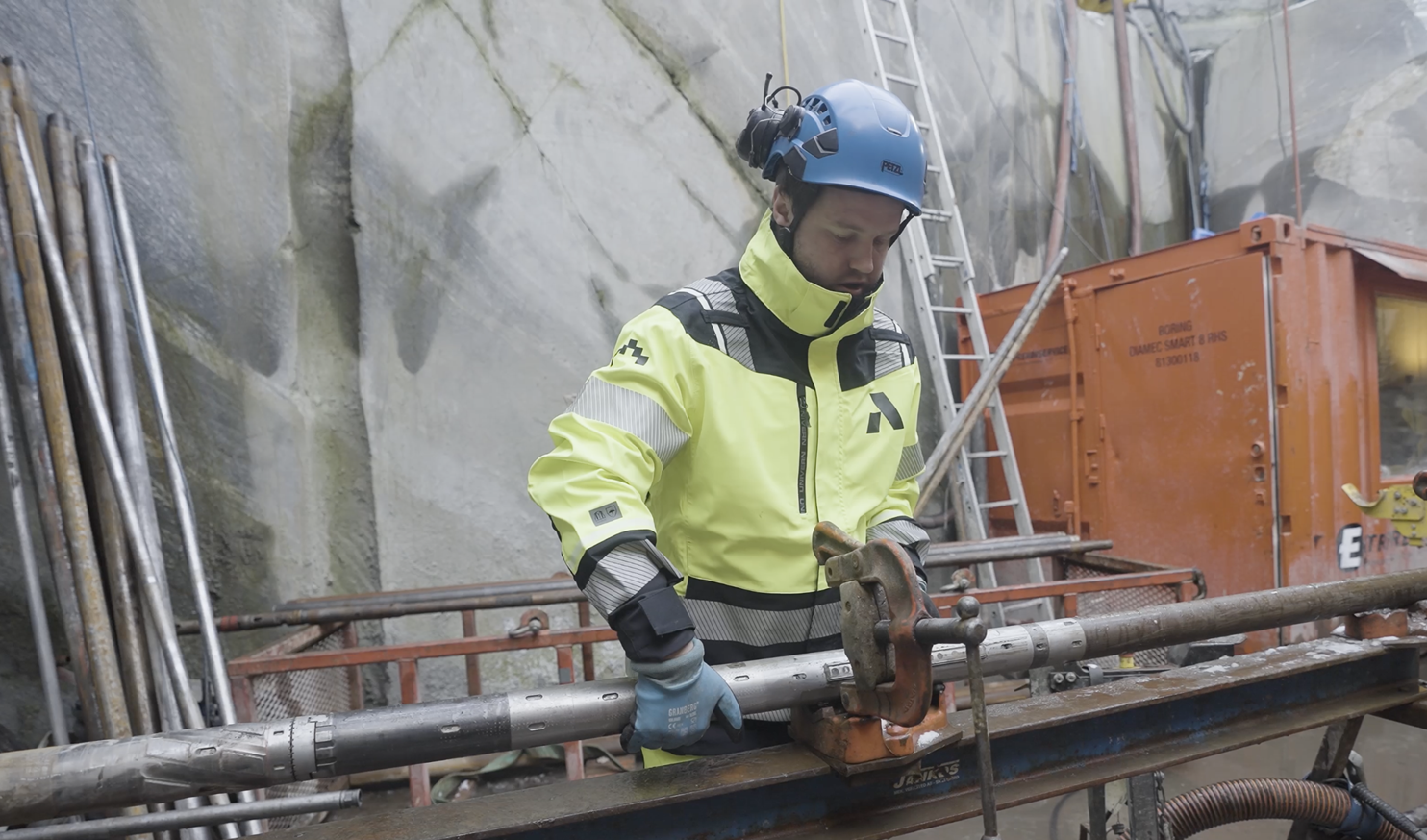
No specialized rig or adapters required
The AZIDRILL® directional coring system operates within a standard core barrel configuration.
AZIDRILL swaps in for a conventional core barrel with no special adapters, extra space, or dedicated gear, If the rig can run a standard core barrel effectively, it can run AZIDRILL the same way.
– Hamish says.
For contractors responding to mine services tenders, that means directional capability can be added to a scope without rig modification or dedicated equipment. The HQ barrel weighs around 80kg, which Hamish notes will usually require some form of mechanical aid to lift into the mast and into vehicles for transport, but otherwise the same operating constraints apply as a conventional scoring program.
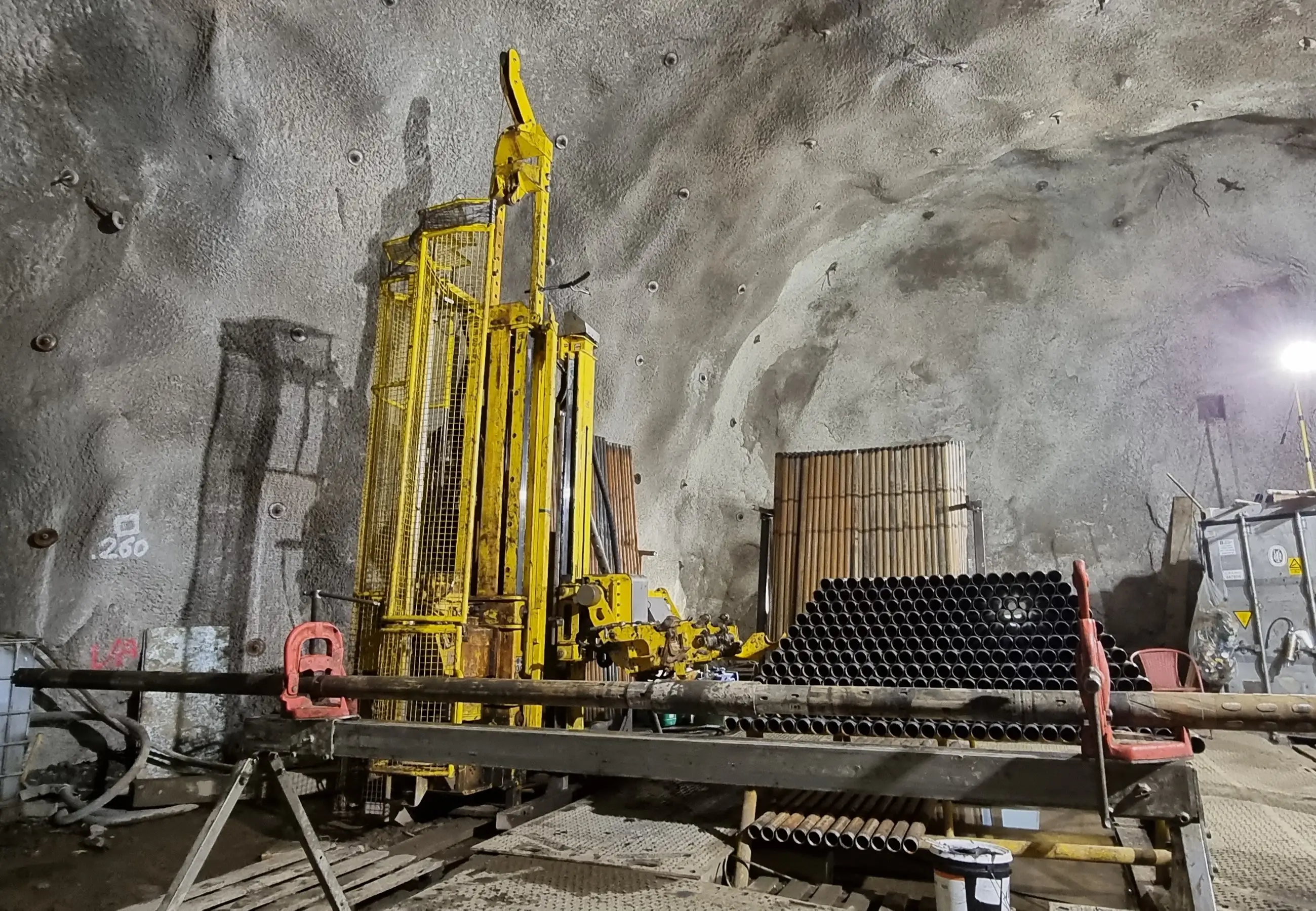
In the hole only when it needs to be
One of the more important operational details for contractors sits in how the tool is actually used on a program. AZIDRILL is only in the hole when a correction or a steered section is required. Once the desired bend rate is achieved and the hole is tracking on target, the contractor pulls the tool and continues under conventional coring parameters.
That has two consequences worth understanding. First, the contractor's drillers run the rig the way they normally would for the bulk of the program, with directional capability stepping in only at defined points. Second, Aziwell's operating model means a single tool and crew can be deployed across multiple rigs concurrently.
We can utilise our service on three, four or even five different rigs moving between holes.We are constantly monitoring the data that the drilling contractors are getting back from their survey results and if needed we will let them know if they are wandering off target and suggest running back in for a correction to get the hole back on target before it gets to a point where the hole may be lost or a correction may cause so much dog leg in the hole that the rod string would be in danger.
Liability and responsibility framework in directional coring
Contractors evaluating directional coring in tenders often ask about operational liability. Haliday clarifies the responsibility split, drawing parallels to oil and gas directional drilling services:
The drilling contractor is the one who will be operating the rig. We are a third-party tool hand essentially. It's a similar model to that of Sperry, Baker Hughes, Weatherford, if we are going to reference oil and gas. We provide the tooling and the systems to plan and track the borepath. We are monitoring and advising of our preferred and allowable tolerances at all times while the contracting party is operating.
– Hamish explains
Responsibility Breakdown:
- Drilling Contractor / Operator: Responsible for rig operation and compliance with recommended drilling parameters. The tooling is third party.The rig operation stays with the contractor.
- Aziwell: Responsible for directional tooling performance, technical advice, and tool mechanical integrity. Mechanical failure or technician negligence on Aziwell's side sits with Aziwell.
- Principal / Mine Owner: Responsible for undisclosed or adverse geological ground conditions. Adverse ground conditions not disclosed before running in hole sit with the principal, the same way they would on any other drilling contract.
The responsibility question is the one most contractors will need to answer before pricing directional capability into a tender. Hamish frames it in terms drilling and oil and gas readers will recognise. Liability splits along familiar lines.
This structure allows contractors to integrate directional coring without altering standard risk management models.
Crew footprint and site infrastructure
Aziwell maintains a minimal operational footprint on site:
- Personnel: One Senior Technician per shift (with a second technician present only during training phases). Rosters typically follow a 2-week on, 2-week off rotation, adaptable to site-specific contractor schedules.
- Infrastructure: A compact site workshop trailer (approx. 10m x 3m) located at the laydown area for tool rebuilding, survey reporting, and borehole tracking.
- Rig Requirements: Only requires parking space for one light vehicle (LV) near the drill rig.
Hamish describes the package as one vehicle and one trailer with everything required to run a project.
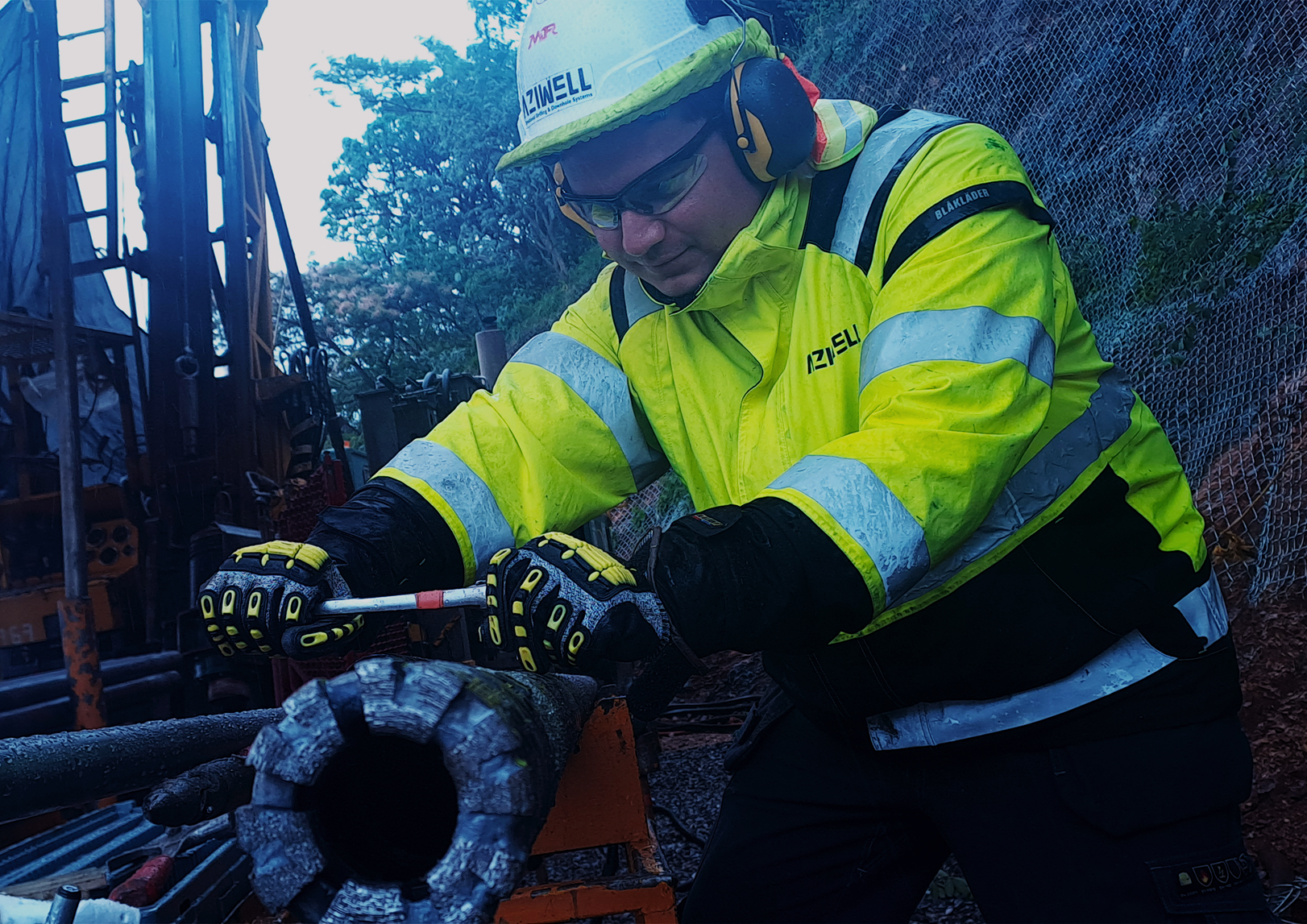
When to Choose Directional Coring over Motor and Wedge Systems?
Hamish is unusually direct about where the technology fits, which is useful for contractors trying to assess when to recommend it on a tender. Directional core drilling delivers the highest return on investment under specific operational conditions:
- The strongest case sits in hard rock requiring high core recovery. The strongest case sits in hard rock
- Where core samples have genuine geological value.
- Deep targets with tight drill spacing tolerances.
- Grade control and resource definition on narrow-vein or steeply dipping mineral structures where conventional coring tends to drift outside tolerance as depth increases.
In hard rock, AZIDRILL's rate of penetration and trajectory accuracy means a steered section can be completed in a shorter time frame than a conventional motor and wedge program, and the total directional metres required to land the target are reduced significantly.
Exception: Sits where there is no requirement for core in the target structure and the overburden geology is not relevant, for example steering above a coal seam, where a traditional mud motor program can be the more economical approach.
The cost-per-target commercial framework
Aziwell positions as a premium service with a premium upfront cost. Hamish does not duck that but argues the line item belongs in a different column.
It may look daunting at first, he says. However, we encourage our clients to look at a cost per target economy, rather than a cost per metre economy.
For contractors, the framing is useful in two directions. It gives them a way to defend the line item when clients balk at the rate, and it gives them a way to push back internally on programs that are being scoped on cost-per-metre logic when the underlying target is the actual deliverable.
Industry demand and capacity outlook
Aziwell's Australian business has grown on the back of repeat work, with programs that start small with new clients tending to scale once the cost-per-target outcomes show up in the data. The company is currently booked out into mid-2027, which Hamish acknowledges limits its ability to respond to short-notice mobilisation requests.
Aziwell is continuing to develop new tools and workflows and is investing in industry reducation to lift familiarity with directional coring among geologists and program planners. Hamish expects the technology to become more standard in mine services as commodity demand pushes the industry to cut total metres drilled and target more precisely.
For drilling contractors, the practical question is narrower. On the next mine services program with deep targets, tight spacing, hard rock and a real need for core, is directional capability worth pricing in. On the operational model Hamish describes, the answer is increasingly yes.
JAMIE WADE
Optimize Your Next Mine Services Drilling Campaign
Are you planning an upcoming drilling program with deep targets, tight spacing, or complex geology?
Aziwell's directional coring solutions can help you eliminate re-drills, reduce total metres, and maximize core recovery while staying on budget. Due to high demand, we recommend contacting our technical team early to discuss project timelines and tool availability.
Ready to evaluate cost-per-target economics for your project?