


Intercepting high-grade gold-bearing quartz veins at depths reaching 2,200 meters presents a significant technical hurdle. When coupled with geological conditions that make natural borehole deviation nearly impossible to forecast, the task becomes a complex challenge, where traditional drilling techniques often fall short.
Radisson Mining Resources Inc. faces this challenge at their O'Brien Gold Project in Québec’s Abitibi district. By using directional core drilling technology, their exploration team is able to drill with great accuracy during a deep step-out campaign. This new approach improved their drilling plan so much that in the first half of 2026 alone, they saved ~30,000 meters of drilling.
The project at a glance
- Location: Cadillac-Bousquet mining district, Abitibi region, Québec, Canada
- Target type: High-grade orogenic gold, quartz veins hosted in the Piché Group at depths of 800m to 2,200m using up to eight drill rigs
- The challenge: Alternating greywacke and argillite with contrasting mechanical properties, causing unpredictable borehole deviation that compounds at depth
- The solution: AziDrill® Directional Core Drilling for top-down trajectory control and precision steering in deep boreholes
- Key result: ~30,000 meters of drilling saved in first half of 2026, with targets successfully intercepted at all depths
Setting the scene: The O'Brien gold project
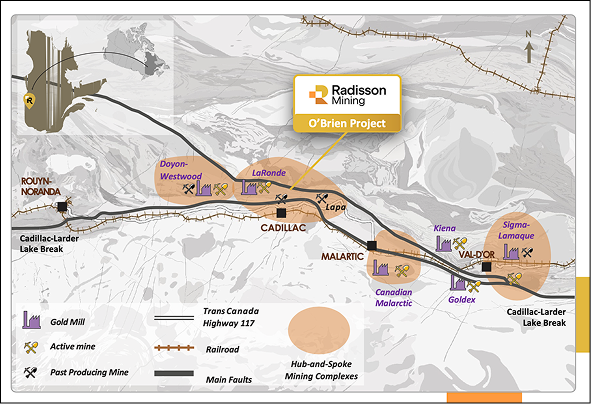
The O’Brien Gold Project is a high-grade gold project, owned by Radisson, located in the Cadillac-Bousquet mining district in the Abitibi region of Québec, Canada. It relies on an orogenic gold deposit located along the Cadillac Break, a prolific gold belt.
A historic high-grade mine
Consisting of gold-bearing quartz veins within the Piché Group, it is made of a combination of mafic volcanic rocks, intermediate intrusive rocks, as well as sedimentary units. Historically, the O’Brien mine produced 587,000 ounces of an average grade of 15.25 g/t gold between 1926-1957.
Interested in learning more about mining for gold? Read our guide to gold mining
Shifting exploration deeper
Radisson has been very active on the property since 2019, drilling over 200,000 meters, and advancing a modern, low-capex, and small footprint mine, built around established infrastructure.
In late 2024, Radisson shifted its exploration strategy toward significant step-out drilling. The area of interest became deeper and beneath the historically mined stopes, and by 2026 every drilling target was below 1000 meters from the surface.
The challenge: Borehole deviation in alternating geology
The geological setting at O'Brien presents a persistent and compounding obstacle for standard core drilling operations:
- The Pontiac Group sedimentary rocks, the hanging wall unit above the Piché Group, creates alternating layers of greywacke and argillite with divergent mechanical traits.
- This results in unpredictable natural borehole deviation that remains difficult to forecast or model effectively.
- At depths exceeding 1,000 meters, minor directional shifts intensify over the length of the hole, often leading to a complete miss of the target veins.
When pursuing high-grade orogenic quartz veins, even a slight inaccuracy renders the effort unsuccessful, providing neither data nor actionable results.
Read also: What is directional drilling?
Why we chose directional core drilling instead of relying on wedges
Wedge deflection was considered as a potential solution. It can increase the number of targets reached per collar while reducing total drilled meters, and in some geological settings it is the right tool. At O'Brien, it was only a part of the solution.
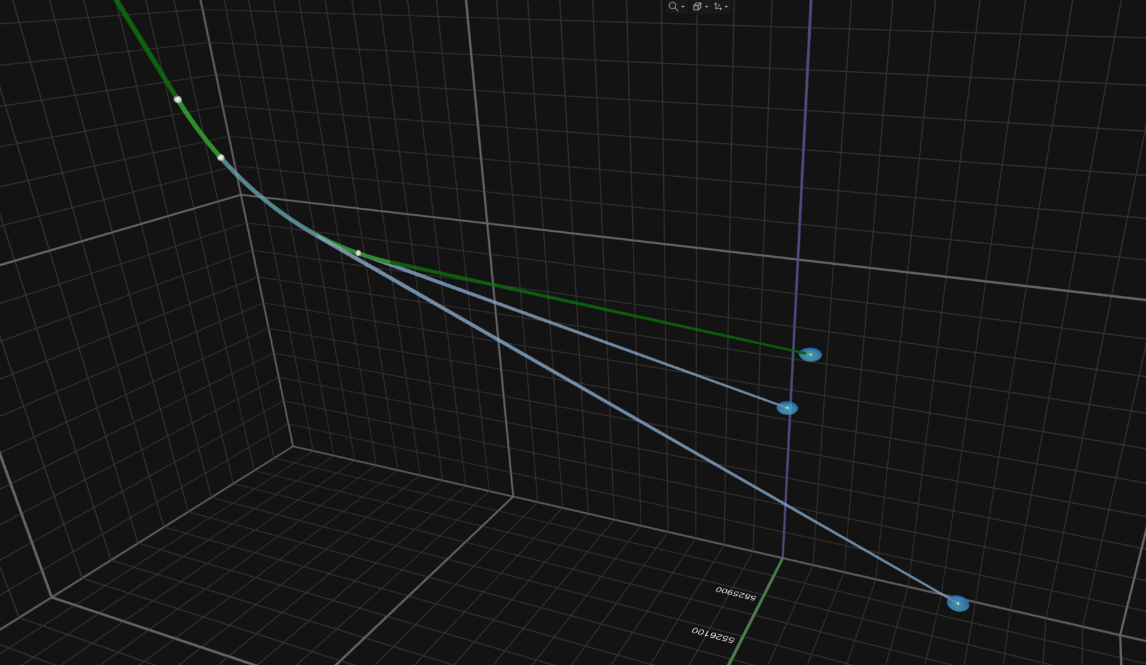
Not only did directional core drilling help assure accuracy in deep boreholes, but it allowed for an optimization of the drilling plan, greatly reducing the drilled meters. The reason comes down to a fundamental difference in how the two methods approach a borehole.
“Directional core drilling is also preferred over traditional iron wedges because it works from the top down rather than the bottom up. This allows the team to step out from known geology in controlled increments rather than drilling a new hole hundreds of meters from the last data point and working back toward familiar ground,”
Said Florian Tormo, Exploration Manager with Radisson Mining Resources Inc.
Where wedges work backward from the end of a borehole, the AziDrill® steers from the beginning and maintains full control of the trajectory as it progresses into unknown geology. In a setting with unpredictable alternating rock, that top-down control is decisive.
Read also: Directional core drilling process
Results at depth
The Aziwell team completed boreholes ranging from 800m to 2,200m, all intercepting their targets with high positional accuracy. Core recovery was maintained through steered sections, preserving the geological data quality that makes deep exploration programs worthwhile. In 2025 alone, ~25,000 drilled meters were saved through the use of directional core drilling.
“Since the beginning of the year, when the Aziwell teams began operations, everything has been going well; targets are being hit with high precision, with optimized corrections, and good communication between the teams.”
Said Florian Tormo, Exploration manager at Radisson Mining Resources Inc.