


In an historic and deceptively complex neighborhood in a Norwegian city, our technology has been crucial in protecting existing infrastructure while also modernizing it. Our goal was to drill a pilot borehole for a new rainwater drainage system, which required navigating hard, fractured gneiss, and unpredictable layers of shale and clay, all while maintaining a clean distance from the nearby critical infrastructure.
Discover how Aziwell's advanced directional drilling technology and the Azidrill system were deployed to correct a conventional drilling drift and drill a long, continuous curve of 376m, resulting in a successful breakthrough right on target.
About the location
The project is set in a quaint and quiet neighborhood in an undisclosed city in Norway. Dominated by open spaces and green areas, it is certainly unassuming enough for one to forget they are still within the boundaries of the city. On one of its rocky slopes, a field of rock carvings was discovered, dating back to the Stone Age, serving as a reminder of the long history of human settlement in the region.
The underground infrastructure
A key feature that keeps it connected and integrated in the area is the underground infrastructure. Not too deep under the hill which dominates the landscape, one can find tunnels for regular traffic.
Project scope
To further improve the infrastructure of the neighborhood, a rainwater drainage channel is being constructed, which needs to avoid all of the major pieces of infrastructure mentioned above. The project required the drilling of a continuously sloped pilot borehole which will connect the high ground to the water. This borehole will serve as the guiding trajectory for said drainage channel.
Read also: Understanding directional drilling
Geological setting
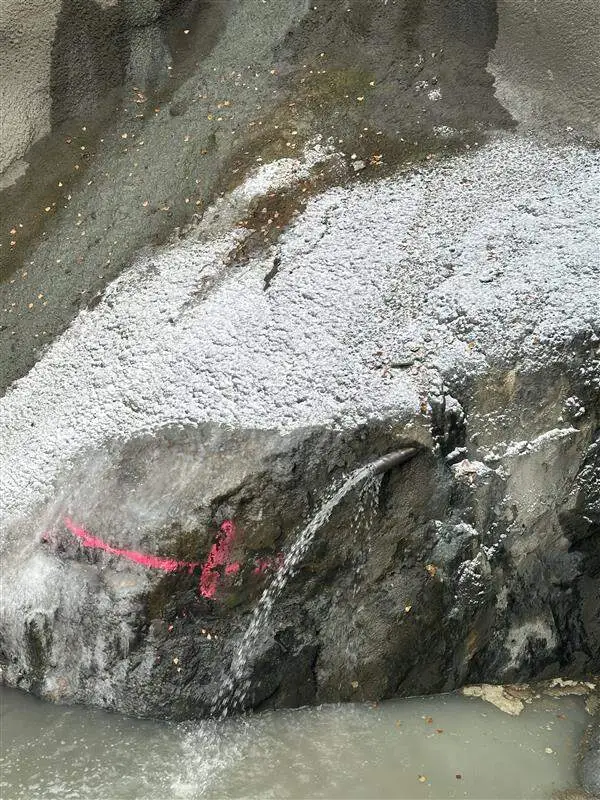
The landscape is dominated by a bedrock of Permian gneiss. There is large escarpment which exposes the rock layers, making it easy for one to observe various rock types, such alum shale with Permian eruptive rocks, the aforementioned fractured Permian gneiss with crushed shale and porphyry veins, and even amphibolites.
This Norwegian region has itself a complex geology because rhomb porphyry lava flows and massive tectonic uplifting shaped the landscape in a dramatic way. For the purpose of directional drilling, the geology of the area is interesting at the very least. There will be hard rock to drill most of the time, but the sharp inclination of the strata makes for sudden transitions between rock types, and the intercalation of shales and clays make it harder to predict how the drill string will behave.
Read also: What you should know about ore mining
Challenges
Drilling in hard rock comes with its pros and cons; on one hand, it is easier to drill a curved path and to control the direction in which the borehole is headed, while on the other hand it is fairly common for the rock to «push» the drilling string in an undesired direction. Furthermore, the fractured nature of the hard rock adds another layer of unpredictability.
Another challenge is presented by veins of eruptive rock, followed by intercalation of shale and clay. This means that even a borehole that is not too long will most likely pass through a wide range of rocks with a wider range of characteristics.
In a situation like this, conventional drilling, which attempts to drill in a rather straight line, might not always lead to the best results, because the borehole will be inevitably moved by the natural deviation of the underground geology.
In this particular case, when a railway tunnel, a high voltage cables tunnel, and a main road need to be avoided (with only a few meters of clearance in each direction), accuracy is not only important, but becomes absolutely critical.
Furthermore, since the borehole needs to be later enlarged into a drainage channel, once a curved path is drilled, that curve needs to be gently maintained, so as to not create issues with the channel construction later on.
Execution
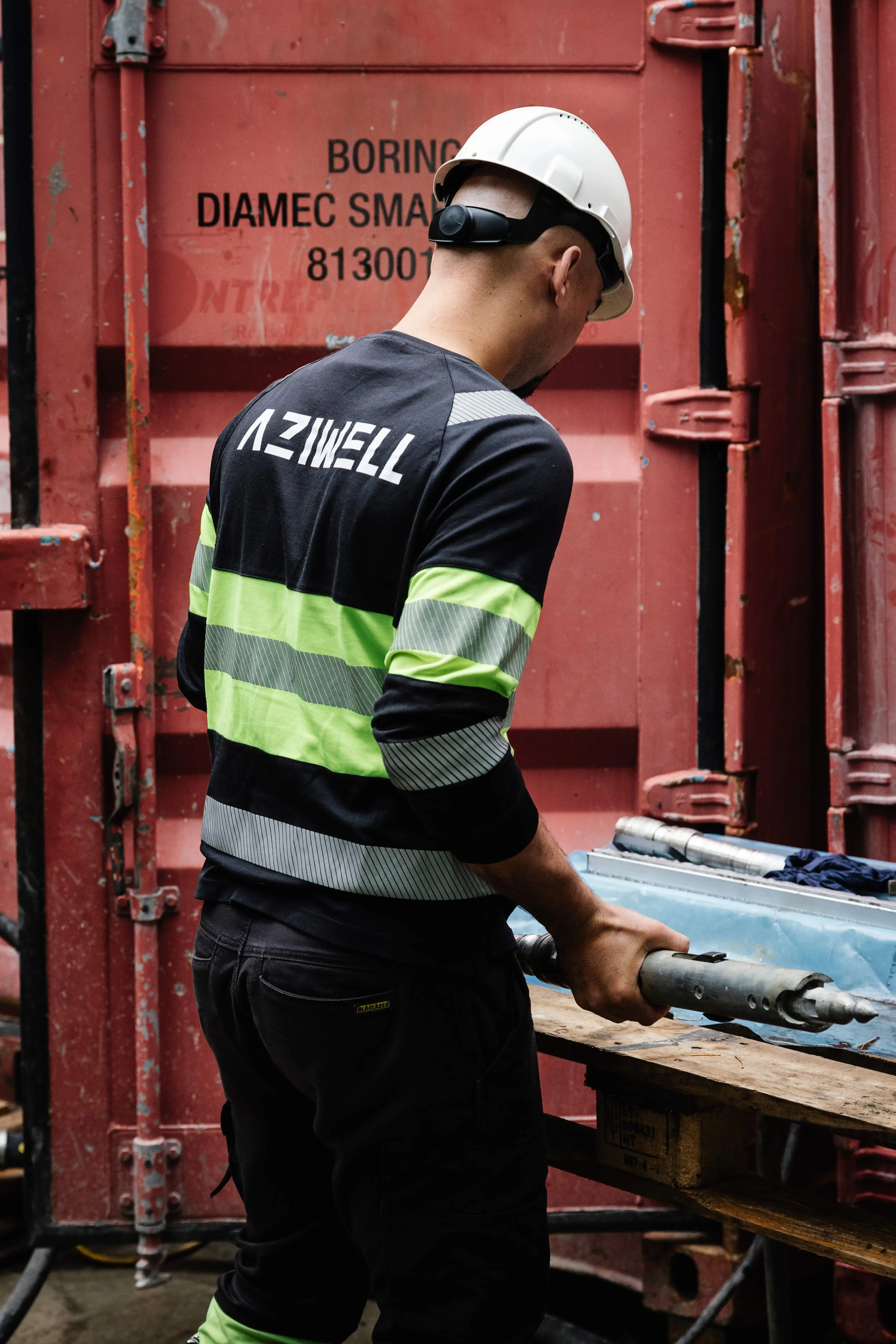
As was expected, after an initial smooth start of the conventional drilling section, borehole surveying showed that the trajectory was slowly drifting away from the ideal path. After the first 80 meters, the borehole started to drift too much to the right. Eventually, when it was determined that the natural deviation might push the borehole too close to the railway, the Aziwell crew was brought on site. We used the Azidrill to steer the hole to the left and get the trajectory back on track.
The plan was slightly adjusted to avoid even getting close to the tunnel and to offer as much room as possible for any other problems that the underground geology will throw at the drilling team. However, after the Aziwell team lifted the borehole and achieved the desired trajectory, we could resume the plan again.
The underground geology did make it as hard as it could. The varied geology of the area did exactly what was expected and threw all kinds of drilling conditions at the team. At times, they were drilling through quartzite, which is extremely hard to drill and can easily cause the drilling bit to become «polished» and unusable; other times they were drilling through layers of clay which makes it harder to control the direction of the borehole.
But despite all of the challenges, the team carefully navigated the borehole through both tunnels, and under the road, making a successful breakthrough within the designated target area.
The DLS was kept at around 4, meaning that every 30m the hole would curve by about 4 degrees. In total, the borehole reached a length of 376m, out of which nearly 300m were drilled using the Azidrill, making for a long continuous curve.
All in all, an astounding success made possible by the smart usage of directional core drilling in general, and the Azidrill in particular.
Watch: The project manager explains the benefit of using the Azidrill
Advanced directional drilling technology in mining
Aziwell is a leading provider of directional drilling solutions and offers service and software products for directional drilling. At the heart of this is our advanced technology, which reduces the environmental footprint through fewer drill pads, operational time, and CO₂ emissions. Our directional drill is precise, does not require special rods or rigs, and has no depth limitations.