


Contents
The technologies that we use in our society today require certain chemical elements that are extracted from minerals. Smartphones, wind turbines, batteries, electric cars, and generally anything with microchips and high-strength magnets in them make use of various rare earth elements, usually in small amounts per unit. However, on a global scale, the demand for these types of minerals is accelerating. This article outlines what rare earth elements are, their role in the green energy transition, and how to optimize mining operations for these highly sought-after resources.
What are rare earth elements?
Rare earth elements (REE) are a group of 17 metallic elements, including 15 lanthanides on the periodic table, plus scandium and yttrium. In the manufacturing supply chain, they are the pure substances used to create high-tech devices, defense systems, and green technology like electric vehicles (EV) and wind turbines.
Minerals vs. elements
It’s important to distinguish the elements from the minerals: Rare earth minerals are the natural solid compounds found in the Earth’s crust that contain one or more rare earth elements. In other words, they are the geological “packaging” that the REEs must be extracted from.
List of rare earth elements
REE are divided into two categories: LREE, which are light rare earth elements, and HREE, which are heavy rare earth elements and generally more scarce and valuable. Here is a rundown of them:
Light rare earth elements
- Cerium (Ce)
- Lanthanum (La)
- Neodymium (Nd)
- Praseodymium (Pr)
- Promethium (Pm)
- Samarium (Sm)
- Scandium (Sc)
Used for
They are primarily used in high-strength permanent magnets for EV motors and wind turbines, glass polishing, and fluid catalytic cracking in oil refineries.
Heavy rare earth elements
- Dysprosium (Dy)
- Erbium (Er)
- Europium (Eu)
- Gadolinium (Gd)
- Holmium (Ho)
- Lutetium (Lu)
- Terbium (Tb)
- Thulium (Tm)
- Ytterbium (Yb)
- Yttrium (Y)
Used for
They are essential for magnets that can withstand extreme heat, fiber optics, medical imaging, and specialized defense applications like sonars and lasers.
Why are they called “rare” earth minerals?
Contrary to what the name suggests, these minerals and elements are not rare or hard to find by themselves, and they are not at all scarce in the Earth’s crust. The “rarity” refers to the difficulty of finding them in high enough concentrations to make them economically viable to mine. As such, we call them rare earths, to emphasize that they are not the minerals commonly mined traditionally (like tin, zinc, iron, or copper, for example) and that they are a highly sought after resource.
New players on the market
Historically, China has dominated the market, accounting for nearly 90% of rare earth market value in recent years. In 2026, we are seeing a strategic shift in the market. While China remains the leader in refining, new mining hubs in Australia, North America, and Brazil are fast-tracking production to ensure supply chain resilience.
Read also: Aziwell is establishes a subsidiary in Australia

A bit of history
We begin in Sweden
In the late 18th century, in the Swedish village of Ytterby, Carl Axel Arrhenius, a military officer who was inspecting the area for a possible fort, found a mysterious black mineral that he could not identify. It was years later that a Finnish chemist, Johan Gadolin, analyzed the mineral and noticed that 38% of it consisted of a new earth element. He named the mineral gadolinite, and the element yttria.
Seven new elements were later discovered in the mineral gadolinite, and a total of nine new elements were discovered in the Ytterby quarry:
- Yttrium (Y)
- Terbium (Tb)
- Erbium (Er)
- Ytterbium (Yb)
- Holmium (Ho)
- Scandium (Sc)
- Thulium (Tm)
- Tantalum (Ta)
- Gadolinium (Gd)
19th century advancements
With further advancements in chemistry during the 19th century, more rare elements were isolated, such as neodymium (Nd), praseodymium (Pr), and lanthanum (La). Eventually, 17 chemically similar elements were discovered which formed the group now known as rare earth elements.
But although scientifically interesting, these elements had little initial use. They were difficult to separate, and they could not be found and extracted in large amounts using the common extraction methods of the time.
Big changes
Everything changed in the mid-20th century, when electronics were developed which made use of such elements. Specialized alloys, powerful permanent magnets, advanced materials, and display screens, all made use of rare earths. Later on, microchips and advanced semiconductors were developed who needed rare earth elements.
Demand suddenly increased as our modern society needed more and more rare earth minerals, and it became important to figure out ways to efficiently mine them.
Mining for rare earth minerals
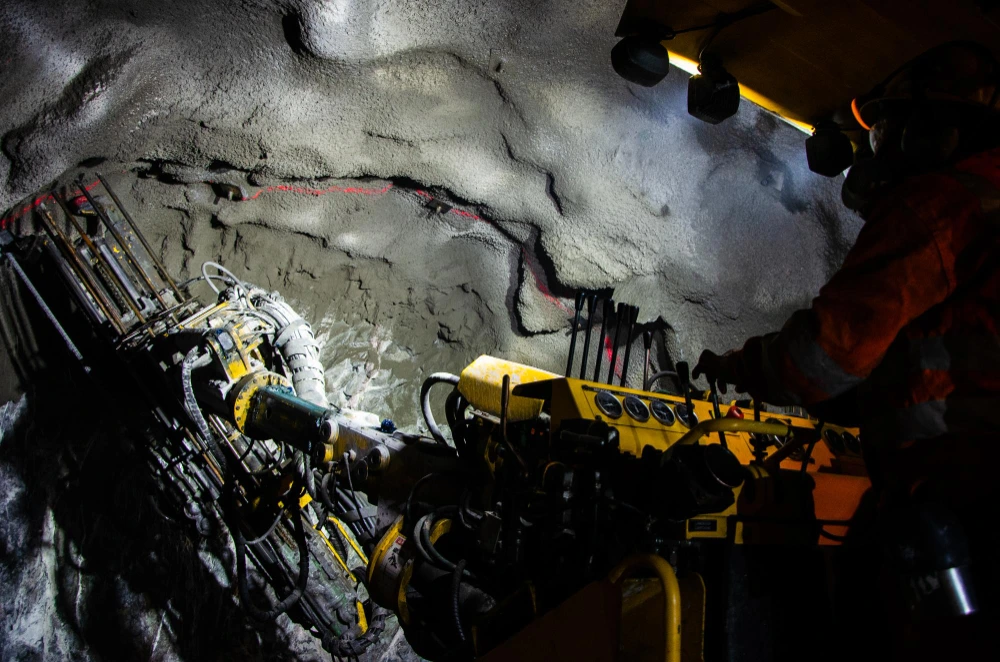
Mining for rare earth minerals comes with its own set of unique challenges, making their efficient extraction anything but straightforward. Unlike many other mineral deposits, it is common to find rare earths as dispersed elements in complex and large geological formations. This means that mining and processing operations require careful planning but also need to employ modern extraction methods and the latest technology.
Mining rare earths: Where are they found?
Although they are generally grouped together as the 17 rare earth elements, and are not that chemically different, they are not all found in the same type of geological deposits. This means they can’t be extracted from the same place, and most importantly, they require different extraction methods.
Most commonly, they can be found in carbonatite deposits, ion-absorption clays, and placer deposits, which are accumulations of heavy minerals in sedimentary formations caused by weathering, erosion, and then gravitational separation.
Conventional mining, or open-pit and underground mining?
Obviously, some types of deposits can be easily mined through conventional mining methods. The above-mentioned placer deposits, for example, can be mined on surface in a similar way to how gold is mined from placers.
Other such easy-to-reach deposits can be mined with open-pit operations, by removing a vast quantity of rock and processing the ore to remove the minerals and later the elements. One example of such an operation is the Mountain Pass mine in California, which became one of the world’s most important sources of rare earths.
Other deposits are found deeper underground and require underground mining, where traditional operations such as drilling, blasting, and ore removal for processing can be employed.
Processing the ore
What separates the mining of rare earths from that of base metals, is the processing of the ore. As the rare earths are almost never found in pure form, and are instead bound within mineral structures, the ways of extracting the elements from the minerals had to be developed specifically for them.
Once the ore reaches the processing plants, it is crushed and ground to free the grains of minerals. Physical separation methods can be efficiently used to gather the rare earths together, such as magnetic separation, gravity separation, or flotation. But because they are so closely related chemically, it can be a nearly impossible task to separate them individually.
Separation of rare earth elements is an intensive process
In fact, the separation of the rare earth elements might very well be, in some cases, as intensive as the mining of the ore itself, and it can easily become far more complex. Solvent extraction is the method most commonly used, where elements are gradually separated through repeated stages of mixing and settling. This seems straightforward, but it may require hundreds of stages to isolate certain oxides with a high degree of purity.
The complexity of the process has led to the concentration of specialized facilities in certain parts around the world and has certainly contributed to the reputation of these elements as being rare.

An increasing need for innovation
While initially rare earths were easier to mine, but harder to process, the modern trend is seeing mining operations becoming more and more complex and challenging.
With the ever-increasing reliance on renewable energy and advanced electronics, more rare earths need to be extracted from less productive ore. With some deposits having very low ore concentrations, a massive amount of rocks needs to be removed to recover a rather small amount of valuable minerals. This will inevitably lead to a higher environmental impact, but also much higher production costs.
To further complicate the matter, many rare earths are found associated with radioactive elements, such as thorium or uranium. There is probably no need to further elaborate how challenging it is to manage radioactive by-products of mining operations.
And certainly, it is understandable why these challenges and increasing costs have prevented mining companies from even attempting to extract certain known deposits. At least until further innovative mining methods become available.
Modern developments in the rare earth mining industry
The rare earth mining industry certainly needed innovation, and many have answered the call. Improved geological modeling and exploration techniques are enabling geologists to identify areas with higher concentrations or valuable minerals (called high-grade zones) with a much higher degree of accuracy. This will, of course, reduce the amount of rock that needs to be removed in order to recover high-yield ore.
Exploration
Also on the exploration side, advanced directional core drilling methods, such as Aziwell’s Azidrill technology, can reduce costs by allowing for less drilling in order to intercept the high-grade zones. It allows geologists to steer the bit. Instead of drilling multiple expensive vertical holes, a single mother hole can be branched into multiple high-grade zones.
Processing
Moving to processing, new methods of extracting the elements and separating them are being tested, which could significantly simplify the entire process. For example, bio-leaching has been proposed, where microorganisms will dissolve certain rare earths from mineral ores. Additionally, new hydrometallurgical processes are being tested and developed.
A case can be made for the recycling of electronic waste as a source of rare earth elements. Microchips, magnets, and certain electrical components from vehicles could be recycled to separate the elements again and be reused in new components.
Future appetite for rare earths
The ways to efficiently mine and process rare earth minerals and elements are still evolving and probably have a long way left to go. But it has become clear already that similarly to how the need for oil has led to giant leaps in the drilling industry, the need for rare earths is revolutionizing the mining industry.
May it be in exploration, ore removal, processing, or metallurgy, our appetite for rare earths is forcing innovation and is expected to have a transformative impact on mining, as a whole.
Key facts you need to know about rare earth elements
- Composition: Rare earth elements are a group of 17 different metallic elements.
- Categories: Rare earths are separated into light (LREE) and heavy (HREE) categories based on atomic weight. HREE are typically more scarce and valuable.
- Usage: The various elements are essential for high-tech devices, defense systems, and green technology.
- Extraction: They are difficult to extract and process.
- Production: China produces roughly 60% of rare earths and controls the majority of processing.
Optimize your next exploration project
The Azidrill is engineered for performance where traditional tools fail. Whether you’re navigating complex mine geometries or executing ESG-compliant civil engineering projects, our technology delivers the data you need with the precision you demand.
Discover how it can work for you
We offer advanced directional core drilling technology
Aziwell is a leading provider of directional drilling solutions and offers service and software products for directional drilling. At the heart of this is our advanced technology, which reduces the environmental footprint through optimized drill-path planning. It allows for multiple targets to be reached from a single drill pad, significantly reducing land disturbance and CO₂ emissions.
Frequently asked questions
What are rare earth minerals?
Rare earth minerals are a group of 17 metallic elements, including 15 lanthanides on the periodic table, plus scandium and yttrium.
What are rare earth minerals used for?
Rare earth minerals are used for high-tech applications like the production of smartphones, electric vehicles, and defense systems.
What is the role of directional drilling in REE exploration?
It allows for precise targeting of deep or complex deposits from a single surface location, reducing costs and the environmental footprint of the project
Does the US have rare earth minerals?
Yes, the US has rare earth minerals. The most prominent site is the Mountain Pass mine in California, but there are new projects emerging in both Wyoming and Texas that strengthen the supply chain.
What country has the most rare earth minerals?
China has the largest reserves of rare earth minerals. Countries like Vietnam, Brazil, and Russia also hold massive untapped reserves that are becoming more economically viable as time progresses.

