


Contents
In the mining industry, directional drilling methods have evolved from mechanical deflections to high-tech steering. These methods, relying on advanced technology, allows geologists to navigate complex underground structures and to plan for better, more precise target localization. This article outlines the most important techniques of directional drilling.
What is directional drilling?
Directional drilling enables the drilling of curved boreholes, which make it possible to hit a specific target with high precision, but also to intercept multiple targets by branching out from the same mother hole. In mining, directional drilling is thus proven to be a cost-effective and often less environmentally harmful method of drilling.
Techniques used in the directional drilling process
- Wedges and whipstocks: Permanent or temporary mechanical inserts placed in the borehole to physically force the drill bit to deflect at a sharp angle.
- Mud motors: Downhole turbines powered by drilling fluid that rotate the bit independently of the drilling string.
- Rotary Steerable Systems (RSS): Advanced steering tools that allow for continuous rotation of the entire drilling string from the surface.
The use of wedges and whipstocks
The oldest method of changing the direction of a wellbore, wedges and whipstocks are angled pieces of equipment that are placed downhole and force the drill string to bend, which will result in a kick-off and directional drilling.
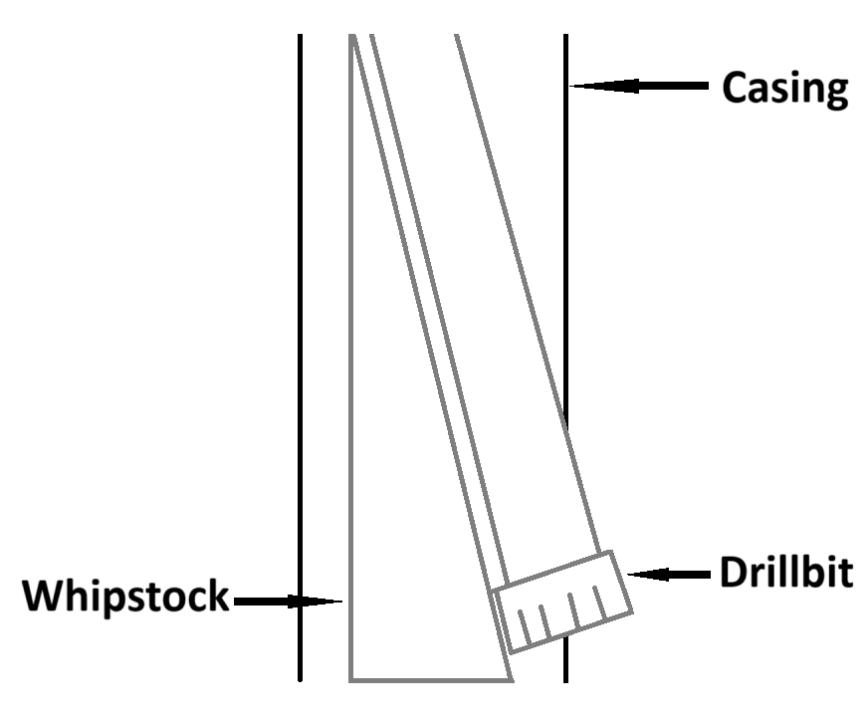
Though simple and with low initial cost, they produce a rather large initial bend which can become problematic later. The drill string could be under too much torque at the kick-off point, damaging the drill rods, or one might have to install multiple wedges and whipstocks to keep the borehole on the desired path, further increasing the risks associated with them.
The mud motors mitigate issues with wedges and whipstocks
Deploying mud motors is a way to mitigate the issues with wedges and whipstock. A mud motor can more reliably drill gentle curves towards a target, and it can be adjusted based on the conditions of the borehole.
How do mud motors work?
Mud motors are essentially downhole turbines that are being rotated by the drilling fluid. The rotation is then transmitted to the drill bit, and through the use of a bent sub or housing (an angled piece of equipment above the drill bit), the borehole can be drilled in curved paths, towards the intended target.
Limitations to mud motors
Mud motors need much more fluid to be pumped through, and it usually requires “sliding” to be effective at drilling in the correct path. The slide happens when there is no rotation applied to the drill string from the rig, but the drill bit is being rotated only by the mud motor itself. This tends to slow down the rate of penetration significantly.
Another major limitation of the mud motor is that it can’t retrieve the core. That is not a problem for oil and gas drilling, but when drilling in hard and compacted rock (either for geotechnical purposes or for mineral exploration) this further reduces the rate of penetration and reduces the geological information that can be retrieved while drilling.

Rotary Steerable Systems (RSS) eliminates the need for mud motors
A further improvement on the technology and methods, Rotary Steerable Systems (RSS) are designed to be rotated from the surface, eliminating the slide of the mud motor. They can be either controlled by pressure fluctuations in the mud column or variations in the drill string rotations to turn the bit in the desired direction.
How do RSS work?
By drilling a rotary throughout the curved part of a borehole, higher rates of penetration can be achieved, since weight can be transferred more directly to the bit. With a steadier path, the borehole geometry will be improved as well, opening up the possibility for more complex paths and longer curves. Another often overlooked advantage of RSS is the lower water consumption, since they don’t need a lot more fluid to be pumped to rotate a downhole motor.
Advanced technology
Modern specialized Directional Core Drilling (DCS) tools – such as the Azidrill, for example – are mostly RSS, because mud motors can’t recover the core.
RSS in directional drilling
There are two main methods that RSS employ for directional drilling.
Push the bit
Through the use of pads on the outside of the tool, the drill string will be forced inside the borehole at an angle. This will lead to the drill bit to deviate from a straight line and drill in a curved path, which then can be pointed at the target.
Point the bit
Common in DCDs, this method relies on a bent caused by pads or bushing to an internal drive shaft. The bend will be transmitted to the drill bit, but the exterior of the drilling tool will not be bent or forced inside the borehole.

Summary
Moving from traditional wedge methods to advanced RSS technology, symbolizes a massive shift in directional drilling methods and in the mining industry in general. RSS technology is far superior to wedges and mud motors as it allows for rock penetrations while also recovering core samples. Thus, modern directional drilling methods ensure a smoother borehole, lower water consumption, and unprecedented precision.
Continue reading about directional core drilling
- The directional drilling process
- The equipment used in directional drilling
- The history of directional drilling
We offer advanced directional core drilling technology
Aziwell is a leading provider of directional drilling solutions and offers service and software products for directional drilling. At the heart of this is our advanced technology, which reduces the environmental footprint through fewer drill pads, operational time, and CO₂ emissions. Our directional drill is precise, does not require special rods or rigs, and has no depth limitations.

