


Contents
Directional core drilling has revolutionized the mining industry by allowing operators to steer boreholes along planned trajectories. To bypass obstacles or hit multiple targets, you rely on high-performance directional drilling equipment. This article guides you through the most essential tools, from the drilling rig, to the surveying tools.
Setting the scene
Directional drilling enables the drilling of curved boreholes, which make it possible to hit a specific target with high precision, but also to intercept multiple targets by branching out from the same mother hole. In mining, directional drilling is thus proven to be a cost-effective and often less environmentally harmful method of drilling.
List of equipment used for directional drilling
- Drilling rig: The primary power unit used to rotate the drill string and apply downhole pressure.
- Drilling rod: Steel pipes that transmit fluid from the rig to the bit while extending the depth of the borehole.
- Drilling bit: The diamond-shaped cutting tool at the end of the string designed to cut through hard rock.
- Core tube: An inner sleeve of the core barrel that captures and protects rock samples.
- Drilling fluid: A cooling and lubricating fluid that stabilizes the borehole.
- Core barrel: The outer assembly that houses the core tube and contains the steering mechanism.
- Surveying tools: Instruments that are used to map coordinated, inclination, and azimuth.
- Support equipment: Secondary infrastructure to any drilling project.
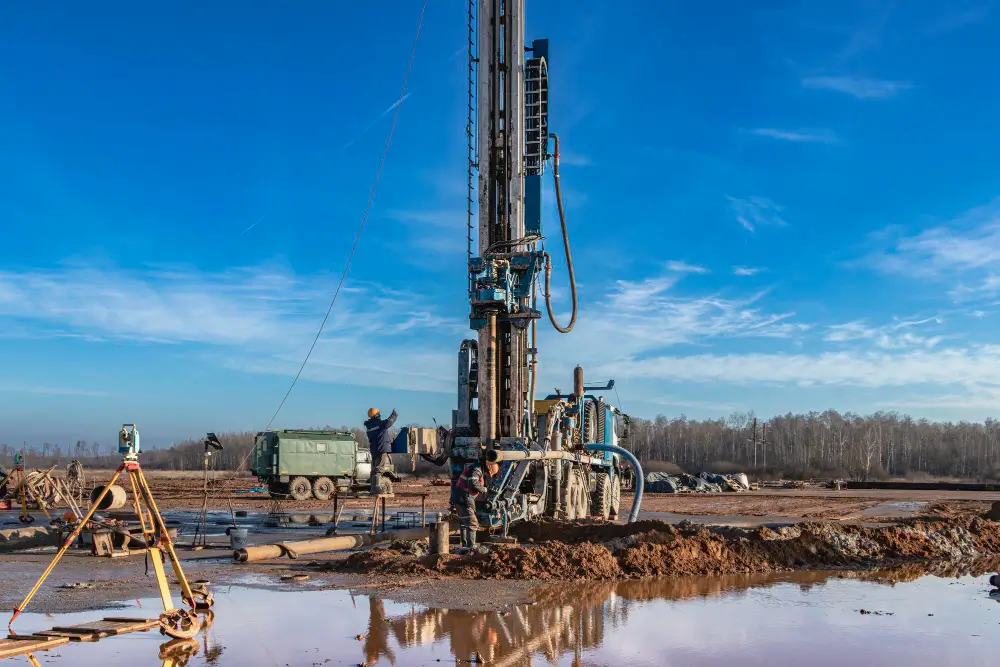
The diamond drilling rig
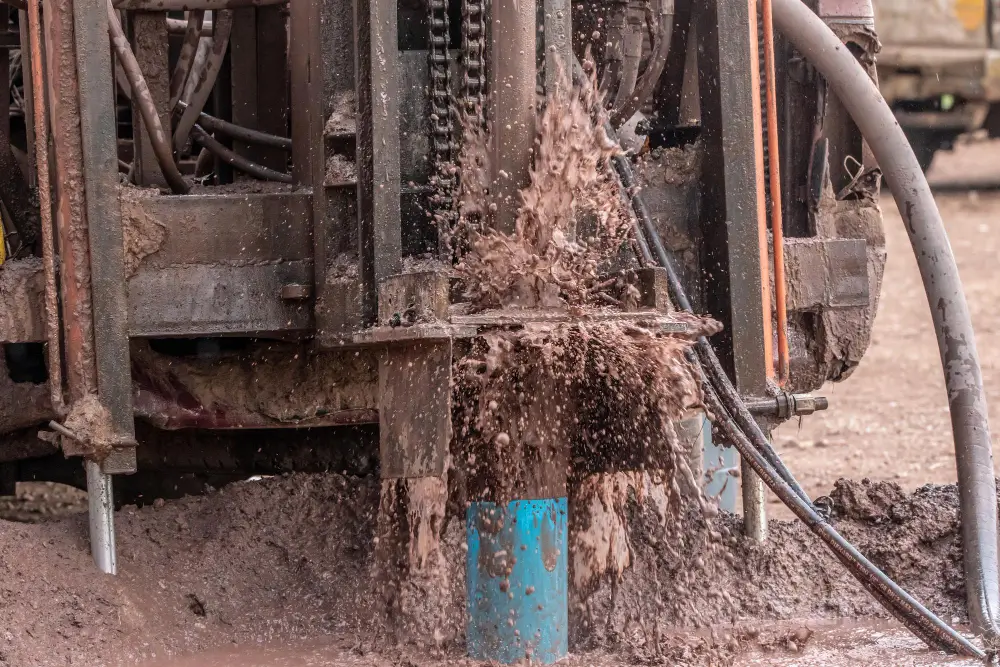
Diamond drilling rigs are specialist tools used in mining and geological industries. It is the most important piece of equipment, whether we’re talking about conventional core drilling, or directional core drilling.
Usually much smaller than the drilling rigs used in oil & gas, diamond drilling rigs are specialized for drilling at high RPMs (Revolutions Per Minute), which are needed for drilling into hard, compacted rock.
How do diamond drilling rigs work?
Diamond drilling rigs can be operated either by internal combustion engines or electric motors, and the overwhelming majority of those in service today are using a top drive to rotate the drilling rods and apply weight to the bit. They are usually equipped with a wireline system that is instrumental in recovering core tubes after they have been filled, or running surveying tools downhole.
Read more about the diamond drilling method here
The drilling rods
Drilling rods, or drill pipes, are the steel pipes which are used to advance the borehole in length and to transmit the rotation and weight from the top drive to the drilling bit. Most often, one will find 1, 1.5 or 3 meter long pipes on diamond drilling projects.
Size of drilling rods
The standard rod diameter depends on the size of the borehole, and are commonly referred to by letter codes:
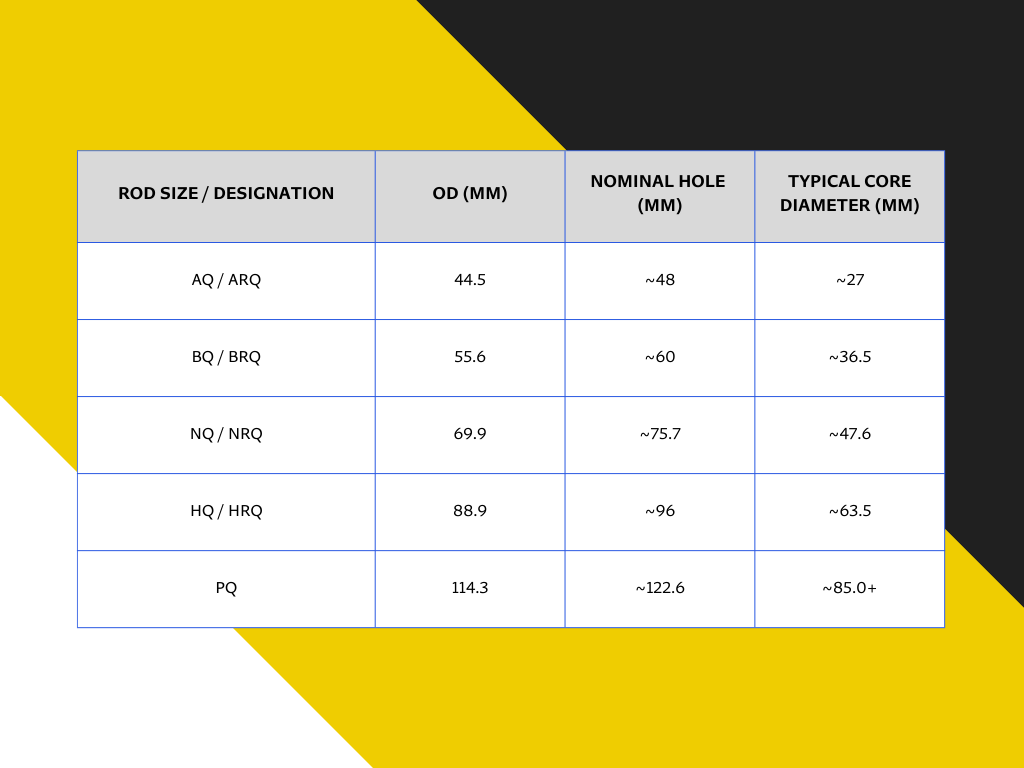
Different qualities
Though they may look similar, not all drill pipes are made the same. Different alloys and different production quality will lead to varied stiffness and durability. This is an important factor during directional core drilling – and of course even directional drilling without core recovery – because different rods have different resistance to high DLS.
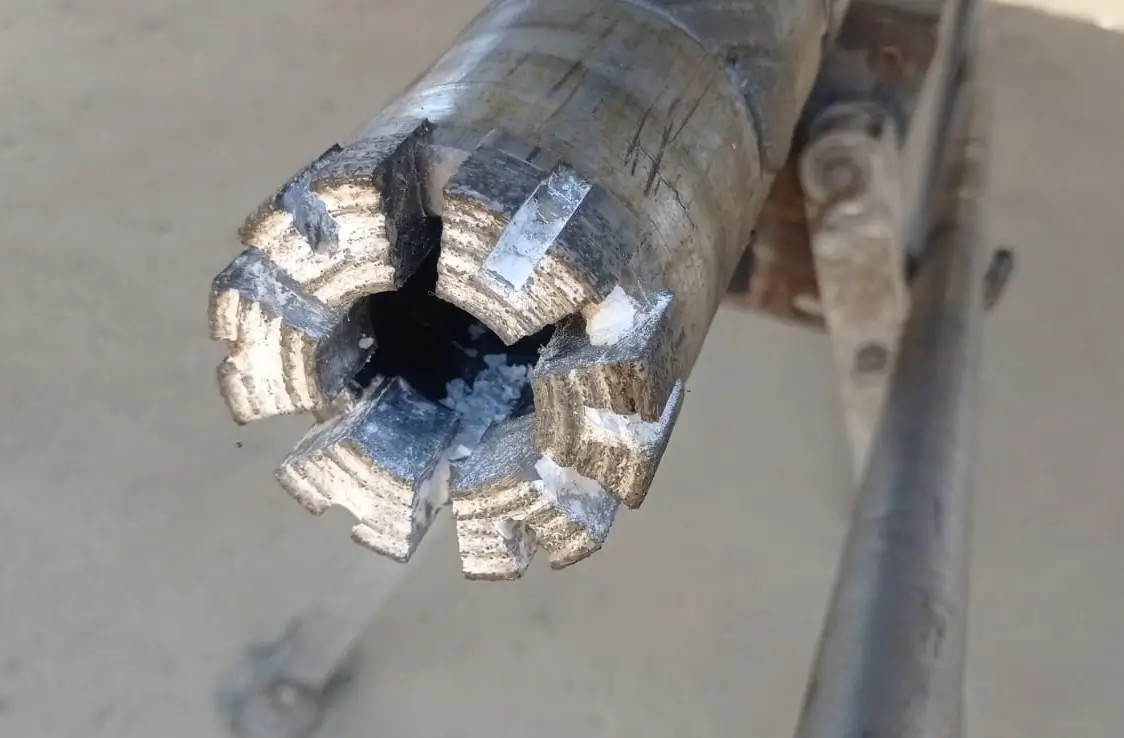
The diamond core drilling bit
The drilling bit used for directional core drilling is similar to that used for conventional core drilling but will usually have a smaller inner diameter. The reason for it being that a directional core barrel needs to have an internal mechanism that produces a bend inside the barrel, which means that there is a smaller space inside for a conventional core tube.
The diameter of the core bit generally determines the size of the borehole, though oversized reamers can be used to slightly enlarge it. As seen in the table above, the nominal hole size will correspond with the bit size.
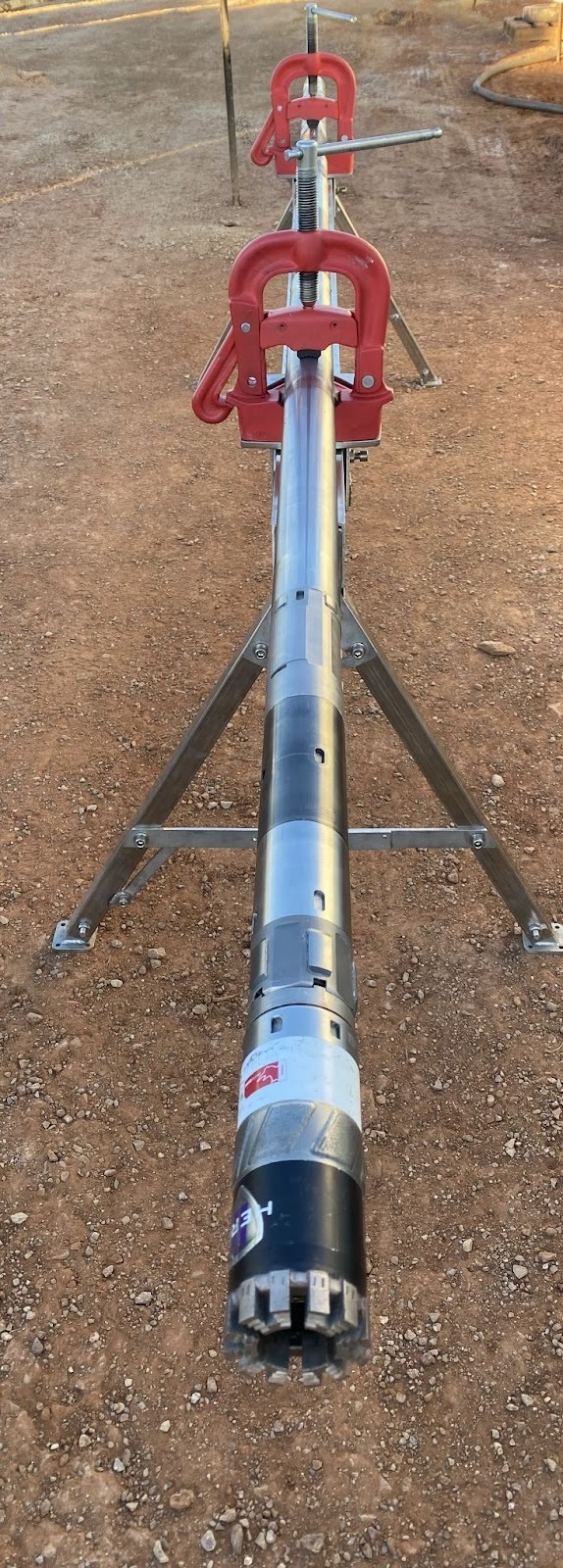
The core tube
A core tube is a metal pipe which gathers the core as it is being drilled. It is part of the core barrel assembly, and used to retrieve rock or soil samples (cores) during drilling. Once it is filled, it will be recovered to the surface via the drilling rig’s wireline system, and emptied. After it will be brought back downhole for another run.
Core tubes are typically 3 meters long, and the diameter of the ones used for directional core drilling are smaller than that of the conventional drilling core tubes for the same borehole diameter, as explained above.
The drilling fluid
The drilling fluid plays a crucial role in all drilling operations. It needs to ensure proper lubrication and cooling for the drilling bit, and to wash away cuttings. Most often, water will be used as a fluid, but in projects where fractured rock is present, or clay can present a problem, specially formulated drilling muds could be used. These are specialized mixtures designed to mitigate a specific problem, such as preventing fluid loss through fractures, or preventing the hydration and expansion of downhole clay.
The directional core barrel
By far the most important piece for the directional part of the core drilling operation, the directional core barrel is there to make sure the borehole advances in the intended direction by drilling in a curved pattern.
Though there are multiple ways to achieve a bend in the drill string which will lead to a curved borehole, the most common method used for directional core drilling is point-the-bit. This means there will be a force applied to an internal drive shaft which will angle the bit slightly in relation to the outside of the directional core barrel, resulting in drilling a curve.
Surveying tools
Either magnetic or gyroscopic, surveying tools are used to track the progress of the borehole and make sure the desired parameters are reached. This includes the inclination angle and azimuth. Without knowing where the borehole is heading, there is no way to know if the target can be intercepted.
Read more about borehole surveying
Support equipment
Power generators, cranes, fluid pumps, and various vehicles are common on a diamond drilling site.
Summary
The synergy of the different tools deployed in directional drilling projects produce magical results. While the diamond drilling rig offers the raw force required to penetrate the surface, the specialized core barrel and surveying tools help to steer the machine. As mining and mineral exploration projects become more and more complex, advanced technology serves as the backbone to a successful operation.
Continue reading about directional core drilling
- The directional drilling process
- The methods used in directional drilling
- The history of directional drilling
We offer advanced directional core drilling technology
Aziwell is a leading provider of directional drilling solutions and offers service and software products for directional drilling. At the heart of this is our advanced technology, which reduces the environmental footprint through fewer drill pads, operational time, and CO₂ emissions. Our directional drill is precise, does not require special rods or rigs, and has no depth limitations.

