


Anyox was one of Canada’s most prolific mining towns before shutting down operations in 1935. Today, its future lies in the deep-seated VMS targets recently identified through modern electromagnetic air surveys. Navigating these targets at ~1000 meters requires a choice: rely on conventional drilling and accept the high cost of inevitable redrills due to natural deviation, or utilize precision steering.
By integrating historical context with Aziwell’s AziDrill® technology, the Anyox project demonstrates how directional core drilling makes deep exploration more cost-effective. By eliminating the need for multiple attempts to hit a single target, the AziDrill® ensures that remote, helicopter-access projects remain within budget and on schedule.
The project at a glance
- Location: Anyox, British Columbia (Golden Triangle)
- Target type: Deep Volcanogenic Massive Sulfide (VMS) identified via air surveys
- The challenge: ~1000 m depth where natural deviation made conventional methods less efficient
- The solution: AziDrill® Directional Core Drilling technology for precision steering
- Key result: 100% target interception with zero redrills, reducing the total project cost
Understanding the location
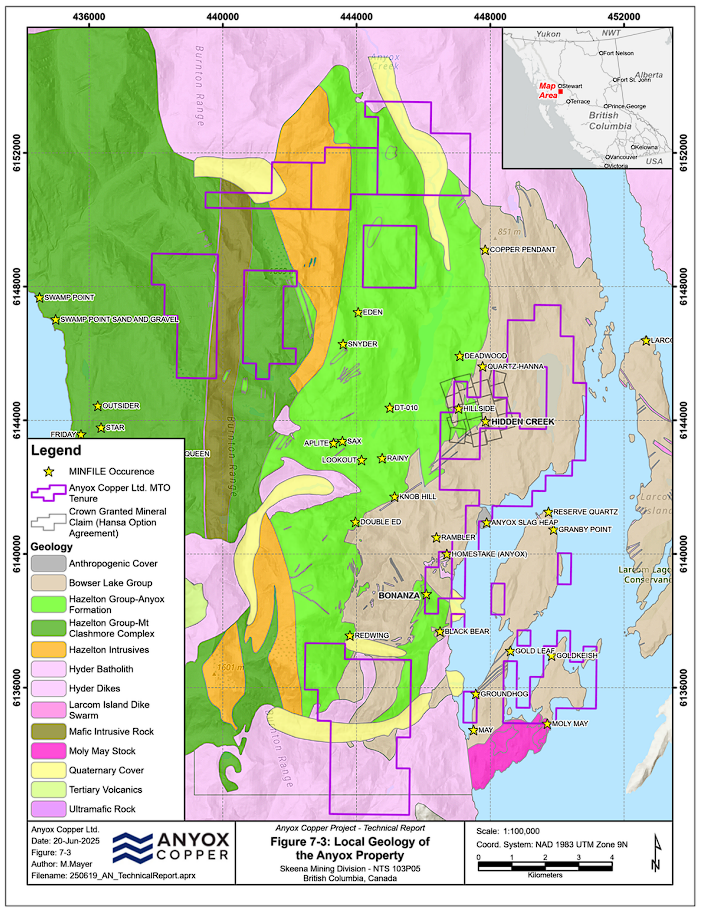
Located in the Golden Triangle of British Columbia, the Anyox Property’s geological setting is one quite familiar to many who have engaged in mining and exploration in the region.
The mineralization itself is primarily hosted within the mafic volcanic rocks near the contact between the Early to Middle Jurassic rocks of the Iskut River Formation of the Hazelton Group with the overlying Middle to Late Jurassic rocks of the Bowser Lake Group.
Though the district contains several deposits, the Hidden Creek deposit is the one of most interest on the property and by far the largest, where the geological team was primarily looking for copper, zinc, and gold.
It is a mafic-siliciclastic Volcanogenic Massive Sulfide (VMS) in massive and pillowed flows of mafic rocks and is overlain by bedded cherts at the contact with overlying turbiditic sedimentary rocks of the Bowser Lake Group. It contains numerous massive, semi-massive, and stringer mineralization lenses, dominated by chalcopyrite-pyrite-pyrrhotite.
Historical background
Speculators have been attracted to the region for years before gold was discovered, due to native legends that told of mountains of gold. Eventually in 1910, the Granby Consolidated Mining, Smelting and Power Company found gold and massive mining operations began in 1914, lasting until 1935.

During 1914 until 1935, the Hidden Creek deposit saw more than 21 million tons of ore mined, from eight ore bodies and across a vertical range of about 400m, producing mostly copper, but also gold and silver.
Another deposit was Bonanza, which was mined from 1928 to 1935, from which about 0.7 million tons of ore were extracted.
All mining at Anyox stopped in 1935, leaving behind a ghost town.
Read also: What is diamond core mining?
The challenge: Missing crucial information
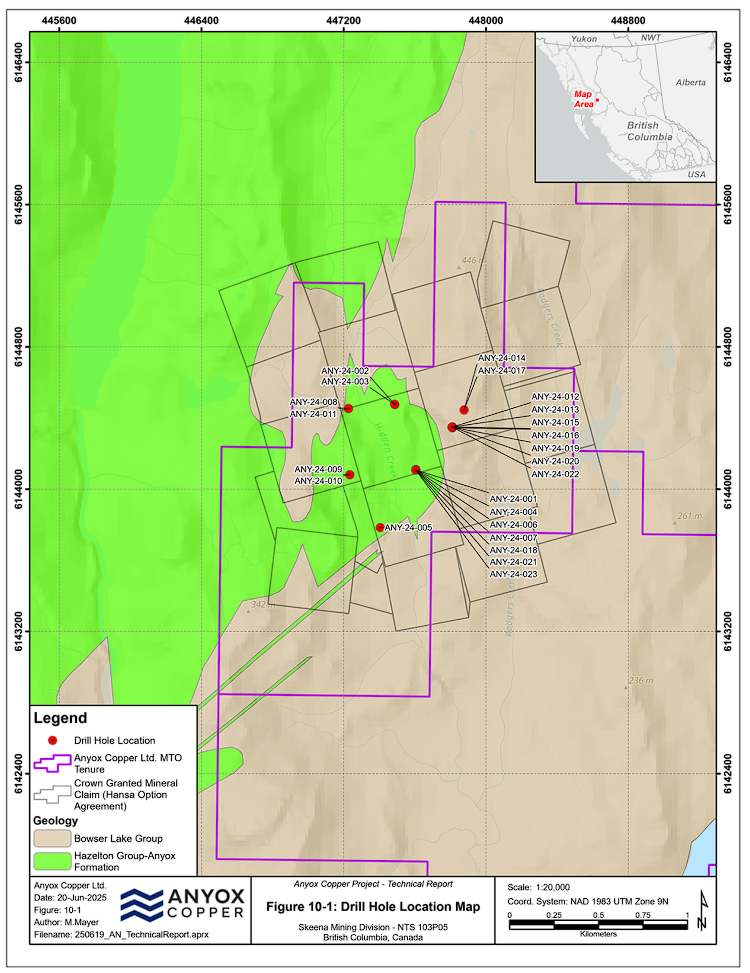
Although large mining operations took place, there was a lack of extensive modern drilling at Anyox. Aside from the confirmation of the subsurface rock formations or identification of mineralized areas, older boreholes can give other valuable information such as the natural deviation of the geological formations drilled. By applying the known deviation to the planned future boreholes, one could estimate how they will deviate from a straight trajectory, and plan accordingly.
Since this information was not available at the Anyox Property, the accuracy of conventional core drilling would have been questionable at best. Boreholes can easily deviate unexpectedly making it a particularly difficult challenge to hit deeper targets.
And indeed, some of the targets were deep. At more than ~1000 meters in total drilled length, some of the boreholes extended for such a long distance that the natural deviation would push the trajectory past the acceptable tolerance of target interception.
Adding the fact that they were placed on a conductive plate identified through electromagnetic geophysical surveys, made it both critical and challenging to accurately hit them with the use of conventional core drilling alone.
Read also: What is directional drilling?
The solution: Using the AziDrill®
In such cases, it is best to use directional drilling technology that can make sure the borehole stays on the desired path and the target will be intercepted. Furthermore, using directional core drilling, in particular, means that drilling can be faster than if full-face directional drilling methods would be used, and valuable data can be recovered through coring during the curved section of the borehole.
By employing Aziwell’s directional drilling technology, accuracy could be guaranteed regardless of the natural deviation of the drilled formations. In practice, this meant eliminating any need to redrill holes that would’ve otherwise deviated too much from the intended trajectory.
The Aziwell team was employed particularly on deeper boreholes, where the directional coring technology of the AziDrill® proved critical for their accuracy. Even in boreholes longer than 1,200m, the AziDrill® helped keep the path on target, reducing the reliance on legacy boreholes for planning and making sure the ore body was properly intercepted and mapped.
The precision of directional drilling
"Because we lacked a reliable deviation model, our drill holes were deviating unexpectedly. Directional drilling proved to be a very useful tool in overcoming these challenges and maintaining the accuracy needed for our deep targets."
– Fernando Costa, Senior Project Geologist with Equity Exploration Consultants Ltd.
Ready to hit your deep targets with precision drilling?
Contact our technical team today to discuss your next project.
Advanced directional drilling technology in mining
Aziwell is a leading provider of directional drilling solutions and offers service and software products for directional drilling. At the heart of this is our advanced technology, which reduces the environmental footprint through fewer drill pads, operational time, and CO₂ emissions. Our directional drill is precise, does not require special rods or rigs, and has no depth limitations.