


Contents
For decades, hard rock mineral exploration has faced a difficult choice: achieve precision targeting or recover high-quality geological data. This article explores how modern directional core drilling tools, specifically our Azidrill, is eliminating this trade-off, allowing operators to steer through the hardest formations while maintaining core recovery and reducing environmental impact.
Backdrop: How hard rock core drilling work
Hard rock directional drilling is a specialized process designed to drill controlled, curved boreholes through high-strength geological formations like granite, basalt, and quartzite.
To penetrate these materials, the drilling industry utilizes coring drills (rather than standard boring drills) that make use of diamond-impregnated coring bits and rotate at higher RPMs. This design minimizes the contact surface between the bit and the rock, while maximizing the rotation and the abrasiveness of the drilling bit. However, as targets become deeper and more complex, traditional deviation control is no longer sufficient.
An increased demand for precision drilling
As the mining industry demands higher precision, the directional drilling technologies from the Oil & Gas sector have been adapted for mineral exploration and hard rock drilling. Historically, two primary tools have defined the market: wedges and mud motors.
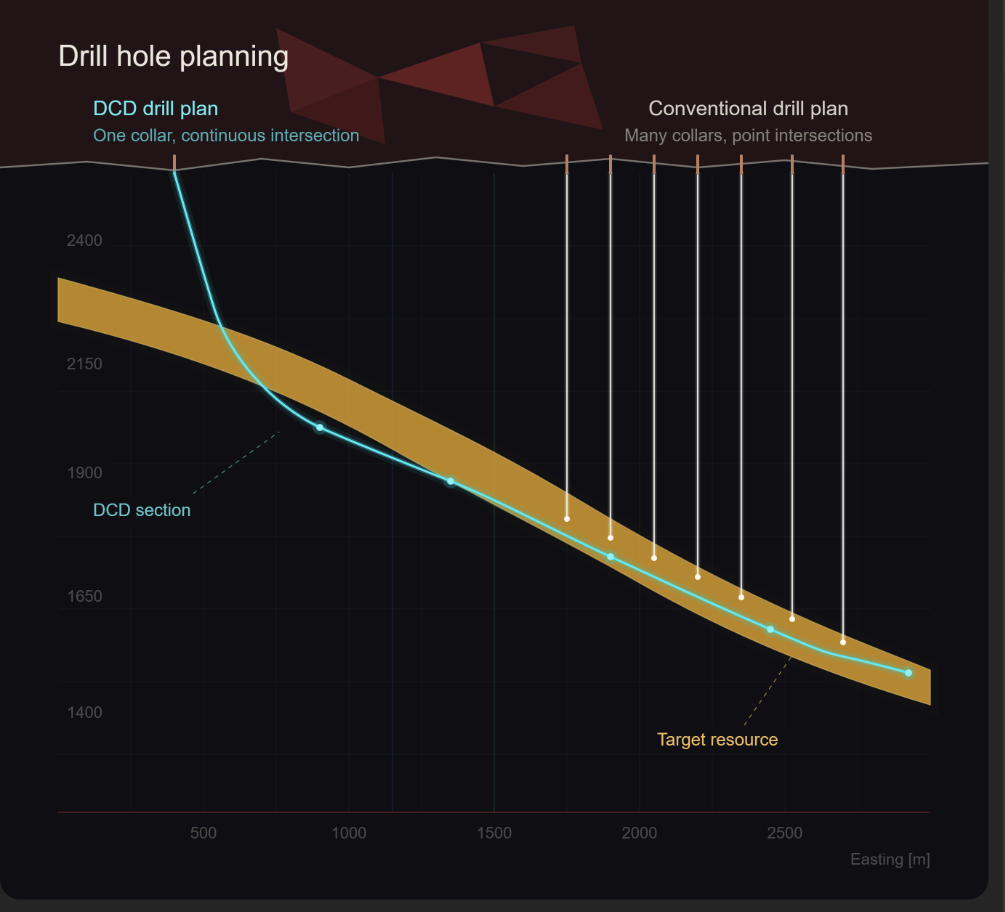
Wedges can impact the angle, but not precision targeting
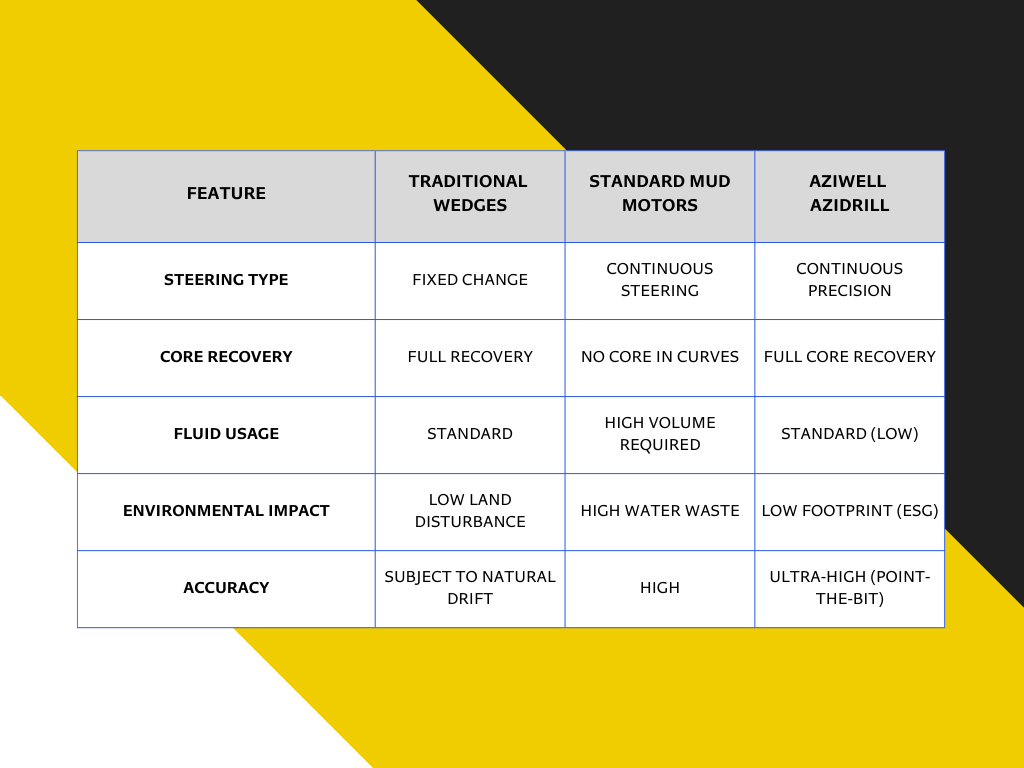
Wedges provide a sharp change in the angle of the borehole at a specific point, but they do not allow for continuous steering and precise targeting. They are especially unsuitable for projects requiring longer, curved boreholes. Furthermore, after the initial change in angle, the borehole remains subject to the natural deviation of the geological formation, creating uncertainty when targeting a specific coordinate.
Mud motors are steerable, but cannot recover core in curved sections
Mud motors solve many of the problems associated with wedges because they are steerable and can facilitate long curves. However, they cannot recover core while drilling the curved section, which results in a much bigger contact surface between the drilling bit and the rock, leading to slower rates of penetration (ROP). Furthermore, since the motor is operated by the flow of drilling mud or water, it requires a vast amount of fluid to be pumped, making it less environmentally friendly and difficult to use in regions where water is scarce.
Problem-solving with Azidrill
Aziwell’s Azidrill solves the challenges of both wedges and mud motors by being steerable, capable of core recovery, and not needing any more water than conventional core drilling.
As a result, higher rates of penetration are achieved compared to mud motors while using significantly less fluid for drilling. Furthermore, much higher precision is achieved compared to wedges, even in longer boreholes or extended curved sections.
Why is Azidrill the new industry benchmark?
The Azidrill resolves the critical “trade-off” in drilling: the choice between steering capability and core data. What allows the Azidrill to be so successful is the clever application of the “point-the-bit” directional drilling technique.
The “point-the-bit” advantage
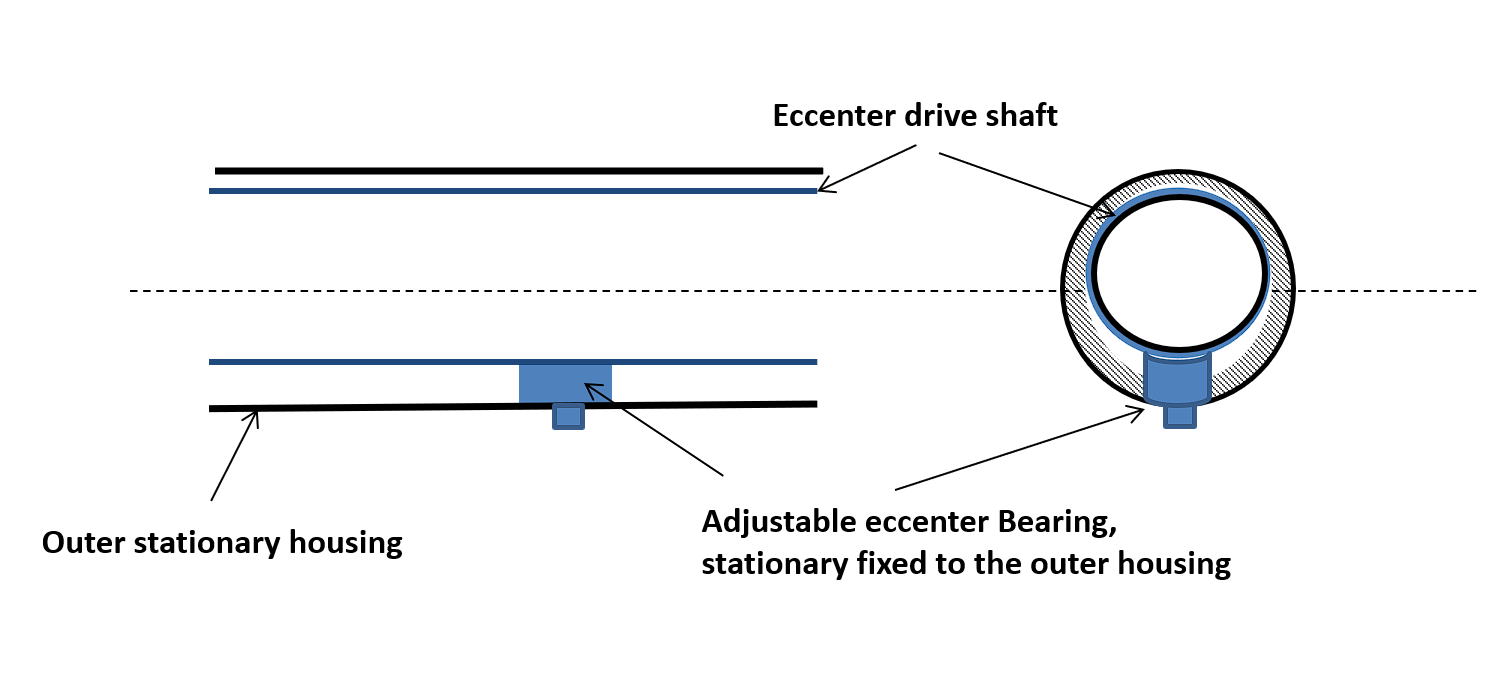
The Azdrill utilizes a sophisticated point-the-bit deflection method. By using a non-rotating outer barrel and a rotating inner drive shaft, a bushing can apply pressure on the inner part to create an angle, which is then transferred to the drilling bit. This allows the tool to drill curved paths, which then can be adjusted from the surface and aimed at a specific underground target.
Unlike the “push-the-bit” systems that rely on side forces against the borehole wall, the Azidrill maintains a consistent trajectory regardless of the weight on bit (WOB). This allows for simultaneous reaming and drilling, ensuring a smooth, high-quality borehole.
Industry-leading core diameters
Data is the most valuable asset in exploration. At the time of writing, there are no other drilling tools on the market that can recover a larger core using this type of technology. While competitors struggle to recover significant samples in curved sections, the Azidrill offers:
- N-size: 40.7mm core diameter
- H-size: 50.7mm core diameter
Integrated navigation with Aziguide
The Azidrill utilizes the Aziguide to measure the Toolface Orientation (TFO) and track its trajectory. Due to the way the Azidrill points the bit, the TFO will always indicate the direction in which the bit is drilling the curve, expressed in degrees.
The Aziguide was developed to read the TFO accurately by using magnetometers to detect the changes in the magnetic field generated by reference screws. By time-syncing the Azugide at the surface, a field operator can read the values recorded during the drilling process to receive the correct TFO
Comparative analysis: Traditional tools vs. Azidrill
Proven economic and ESG impact
Directional drilling isn’t just a technical preference; it is a financial and environmental strategy. Not only is the targeting highly precise, but the Azidrill is consistently employed on projects where it helps shorten the drilling programs by 30-40% drilled meters. That translates into signifiant time and money saved, alongside a reduced environmental impact.
Case study: Dolly Varden Silver, Canada
By deploying the Azidrill at the Kitsault Valley Project, the drilling program was shortened by 6 weeks, resulting in a direct saving of $1.3 million CAD.
Read more about how we deployed our technology in Canada
In short
- Continuous steering: Provides precise targeting that surpasses the limitations of static wedges.
- Uninterrupted core recovery: Recovers high-quality core (N and H size) even while drilling curved sections.
- Water efficiency: Operates on standard water volumes, making it ideal for remote and water-scarce regions.
- Operational savings: Reduces the total meterage by up to 40%, directly lowering costs and environmental impact.
- Advanced telemetry: Uses the Aziguide system for accurate real-time TFO tracking.
Optimize your next exploration project
The Azidrill is engineered for performance where traditional tools fail. Whether you’re navigating complex mine geometries or executing ESG-compliant civil engineering projects, our technology delivers the data you need with the precision you demand.
Discover how it can work for you
Read more about directional drilling
- The directional drilling process
- The equipment used in directional drilling
- The history of directional drilling
- The methods used in directional drilling
We offer advanced directional core drilling technology
Aziwell is a leading provider of directional drilling solutions and offers service and software products for directional drilling. At the heart of this is our advanced technology, which reduces the environmental footprint through optimized drill-path planning. It allows for multiple targets to be reached from a single drill pad, significantly reducing land disturbance and CO₂ emissions – a critical requirement for modern, ESG-compliant geological surveys.

